
 : sherry@gelgoog.com
  : 0086-15515573212







How Potato Chips Are Made in Factory?
 2026-06-30
 Potato chips are a highly popular snack food, and their manufacture involves a comprehensive production system encompassing raw material handling, quality control, forming, frying and seasoning, as well as packaging and storage. Modern potato chip factories typically employ automated potato chips production lines that utilize continuous processing equipment to execute each stage of production, thereby enhancing efficiency while ensuring consistency in the product's color, texture, thickness, and overall quality.
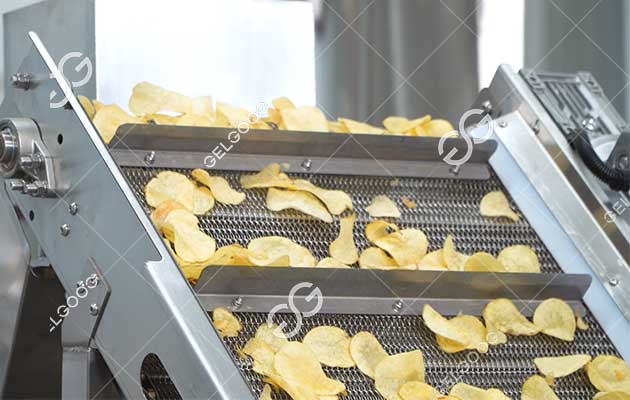
What is the potato chips production process?
1. Washing and impurity removal
Freshly harvested potatoes typically have soil, sand, and other impurities on their surfaces. Factories generally use drum washers, brush washers, or high-pressure water cleaning equipment to clean the potatoes and prepare them for subsequent processing.
2. Peeling
The washed potatoes must be peeled to ensure a more uniform color and texture in the finished chips. Peeling results in a smoother surface, which facilitates the subsequent slicing process.
3. Precision Slicing
Industrial potato chips typically require consistent slice thickness, as this directly affects frying time, crispiness, moisture content, and texture.
4. Starch Removal and Pre-treatment
The surfaces of the sliced potato retain some starch; frying them directly can lead to issues such as excessively dark color and surface sticking. Therefore, blanching is required to remove the excess starch.
5.Dehydration
After washing and blanching, residual moisture remains on the surface of the potato slices. Proceeding directly to the frying stage would cause the oil temperature to drop, extend frying time, and increase the product's oil content. Therefore, a centrifugal dehydrator or air-drying equipment is used to remove surface moisture.
6. Continuous Frying
Frying is the key step in developing the unique flavor and texture of potato chips. The fryer ensures product consistency across batches by automatically controlling oil temperature, conveyor speed, and frying time.
7. De-oiling and Cooling
After frying, the surface of the potato chips retains some oil; a de-oiling process is required to make the chips crispier.
Key Considerations in Potato Chip Production:
1. Controlling Raw Material Quality
Processing outcomes vary significantly depending on the potato variety. If the raw material has an excessively high sugar content, the chips may become too dark during frying; conversely, insufficient dry matter can compromise their crispness. Consequently, factories typically conduct testing and sorting of raw materials.
2. Controlling Slicing Uniformity
Inconsistent chip thickness can result in some chips burning during frying, while others fail to achieve the desired texture.
