
 : sherry@gelgoog.com
  : 0086-15515573212







Analysis of Chicharron Frying Temperature
 2026-03-17
 Chicharron is a highly popular delicacy, cherished by consumers for its crispy exterior. Frying constitutes a pivotal step in the preparation of chicharron. In the following section, we will analyze issues related to the frying of chicharron.
1. What is chicharron?
Chicharron is typically produced using pork skin or pork meat containing a small amount of fat, processed through a series of steps including cutting, pretreatment, and deep-frying. The preparation methods and flavors of chicharron vary slightly across different countries and regions.
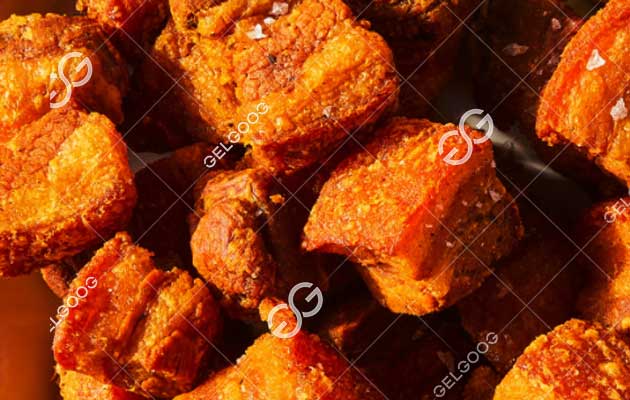
Regardless of regional differences, high-quality chicharron should possess characteristics such as excellent puffing, a golden-yellow hue, a crispy texture, and a non-greasy finish—qualities that are inextricably linked to the deep-frying process.
2. Temperature requirements for frying chicharron
Frying temperature is one of the critical factors influencing the quality of chicharron. Proper temperature control not only determines the product's texture but also directly impacts yield and stability.
The frying temperature for chicharron is typically maintained within the range of 180°c to 200°c.
Temperatures may vary slightly across different stages:
Initial frying stage (pre-frying): Approximately 160°c – 170°c
The primary function of this stage is dehydration and structural setting, allowing the internal moisture within the pork skin to be gradually released.
Secondary frying stage (expansion frying): Approximately 190°c – 200°c
This is the critical stage; the high temperature causes the chicharron to expand rapidly, forming its characteristic crispy structure.
3. Precautions for frying chicharron
To ensure the quality and production efficiency of chicharron, the following key points must be observed during the frying process:
① Thorough pre-processing of raw materials
The pork skin must be washed, de-haired, and cut into pieces in advance. It may also undergo pre-boiling or low-temperature drying treatments to reduce its moisture content.
② Moisture content control
Moisture is a critical factor influencing the puffing effect. Appropriate dehydration helps to: Increase the expansion rate, reduce frying time, and lower oil consumption.
③ Cooking oil management
Use cooking oils with high oxidative stability (such as palm oil). Regularly filter out residues to maintain oil purity, and carefully manage the oil's usage cycle to prevent rancidity from negatively affecting the flavor.
4. Primary equipment for frying chicharrones
With the advancement of automation, modern chicharron production largely relies on specialized chicharron frying equipment; depending on the specific production scale, one may choose between a batch-type fryer or a continuous fryer.
