
 : sherry@gelgoog.com
  : 0086-15515573212







How Are French Fries Made? A Complete Production Process
 2026-09-18
 How are french fries made? From the moment the raw potatoes enter the factory until they are transformed into uniformly sized french fries, the process involves multiple processing steps. In particular, factories catering to the restaurant, foodservice, and frozen food markets must not only focus on the appearance of the fries but also control their shape consistency, moisture content, color, internal structure, and performance during subsequent cooking.
The following outlines the main processes involved in producing french fries:
1. Raw material incoming inspection: First, determine whether the potatoes are suitable for processing
The first step in french fry production is the receipt and sorting of raw potatoes. Manufacturers must select potatoes suitable for french fry production based on product requirements and conduct a preliminary inspection of the raw materials. Potatoes that are rotten, severely bruised, or have obvious defects may affect the quality of the final product.
It is important to note that attention should not be focused solely on the size of the potatoes; the internal condition and processing characteristics of the raw material also affect the final product.
2. Washing: Removing soil and impurities
This step primarily removes soil, sand, gravel, and other contaminants from the surface. During continuous production at a factory, if the raw materials are not washed thoroughly, soil may enter downstream equipment, which not only affects food safety but also increases equipment wear and maintenance demands.
However, stronger washing is not necessarily better. If potatoes are subjected to excessive impact during conveying and washing, they are prone to new mechanical damage. Therefore, in actual production, it is necessary to strike an appropriate balance between cleaning effectiveness and raw material integrity.
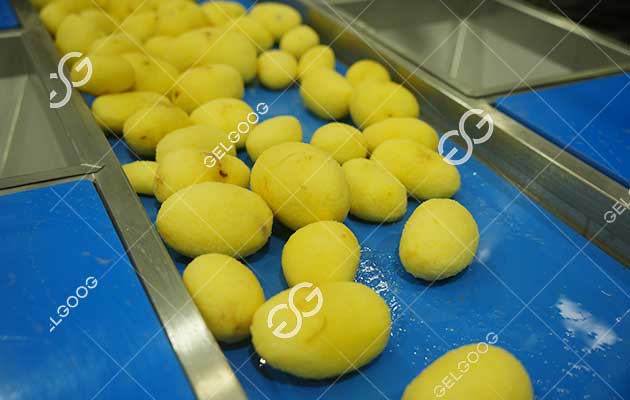
3. Peeling: Minimizing the impact of the skin on the final product’s appearance
The primary purpose of peeling is to remove the skin, ensuring that the resulting french fries have a more uniform appearance.
The key consideration in this step is the degree of peeling. If the potatoes are not peeled thoroughly enough, some skin may remain on the surface of the french fries; if they are over-peeled, it will increase waste of the potato raw material.
4. Cutting into strips: A critical step in determining french fry specifications
After peeling, the potatoes enter the cutting process. The width and length of the french fries directly affect their heating rate, surface color, and final texture. Therefore, during production, it is typically necessary to determine the cutting specifications based on the target product and maintain consistent blade condition.
5. Post-cutting processing: Controlling surface condition
Cut potato strips typically require further processing to adjust their surface condition.
After cutting, the potato surface retains a certain amount of free starch. If not properly treated, the fries may stick together or develop other issues during subsequent processing.
6. Pretreatment: Ensuring greater stability in subsequent processing
In industrial french fry production, a thermal pretreatment step is typically included. The purpose of this process is to subject the potato strips to a certain degree of heat treatment, making subsequent processing easier to control while improving the color and internal structure of the finished product.
It is important to note that there is no single set of parameters for pretreatment that applies to all potatoes; adjustments must be made based on the raw materials and product specifications.
7. Removing surface moisture: Preparing for subsequent heat treatment
After the previous washing and pretreatment steps, some moisture remains on the surface of the french fries. Before entering the high-temperature processing stage, it is necessary to reduce excess surface moisture as much as possible.
The key focus at this stage is ensuring uniformity in the treatment. If some french fries have more surface moisture while others are drier, this may result in inconsistent processing outcomes in subsequent stages.
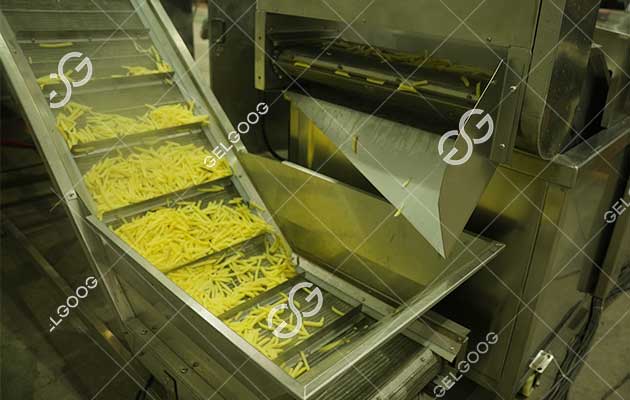
8. Frying or pre-frying: Forming the external structure of french fries
For commercial french fries intended for further processing, frying or pre-frying is a crucial step.
During this process, the french fries are treated in high-temperature oil, causing their surfaces to gradually develop a specific structure and color, while moisture changes continue to occur internally.
For frozen french fries, pre-frying is typically used instead of processing the product to its final edible state in a single step. This allows consumers to achieve a more consistent final product with minimal cooking.
9. Cooling and quick-freezing: Bringing the product to a stable frozen state
If producing frozen french fries, the product must undergo cooling and quick-freezing after pre-frying.
It is important to note that both the freezing rate and the distribution of the product will affect the final product quality.
For factories, the processing capacity of the freezing equipment must be matched to the production speed of the upstream process; otherwise, the entire production line is prone to capacity bottlenecks.
10. Packaging: Ensuring french fries are ready for sale and transportation
Depending on market positioning, products can be packaged in different sizes—for example, bulk packaging for foodservice customers or small packages for the retail market.
For commercial french fries production, the process from raw potatoes to the final product typically involves multiple consecutive processing steps. To minimize manual handling, improve production efficiency, and ensure a smooth transition between different stages, factories typically use a complete french fries production line to carry out the entire processing process.
